

The Colca Canyon is one of the deepest canyons in the world, running about 3,270 meters from rim to river, roughly twice the depth of the Grand Canyon. It sits some 160 kilometers northwest of Arequipa, and it’s the best place in Peru to see Andean condors gliding up close.
It’s also Peru’s third most-visited destination, with around 120,000 visitors a year. But there’s something almost no guide tells you before you book: reaching the Colca means crossing a mountain pass at 4,910 meters, higher than any other point on the southern circuit. If you don’t know that, the altitude catches you off guard.
What is the Colca Canyon and where is it?
The Colca Canyon was carved by the Colca River in the Arequipa region of southern Peru. It runs about 70 kilometers long and is the second deepest in the world, after the Cotahuasi, which is also in Peru. Its gateway is the city of Arequipa, and the base town for exploring it is Chivay.
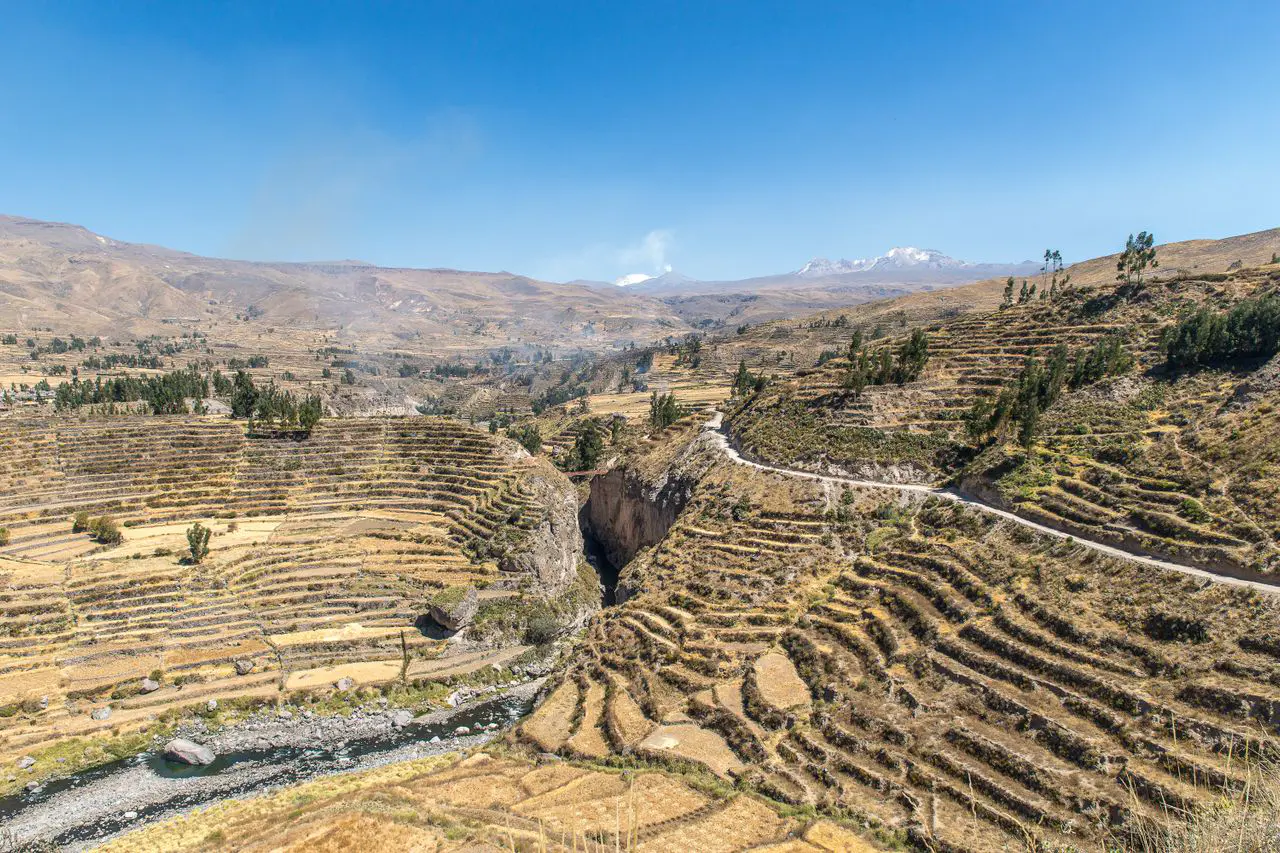
The name comes from Quechua. “Colcas” were the storehouses where the Incas kept corn and potatoes, and this valley had many of them because it was an important agricultural center. That heritage is still alive: the valley is covered in pre-Inca terraces that are still farmed, and the Collagua and Cabana communities keep their traditions in towns like Yanque, Maca and Cabanaconde.
What sets the Colca apart from other canyons in the world is that it isn’t an empty place. It’s an inhabited valley, with colonial towns, terraces still in use, and farming life that goes back centuries.
How deep is it really?
The Colca Canyon reaches about 3,270 meters deep from rim to river, roughly twice the depth of the Grand Canyon in the United States. Worth noting: the figures vary by source and measuring point, and you’ll see anywhere from 3,270 to over 4,000 meters, because it depends which rim is taken as the reference.
Now, an honest caveat worth knowing before you go. The Colca doesn’t look as dramatic as the Grand Canyon, even though it’s deeper. The reason is simple: here you’re already standing at 3,300 or 3,800 meters looking down, rather than standing below and looking up at walls towering over you. The scale is enormous, but the visual effect is different.
Cruz del Cóndor: when to see the condors
The best time to see condors at the Cruz del Cóndor viewpoint is between 8 and 10 in the morning, when thermal currents rise from the canyon floor and the birds use them to glide. That’s why tours leave Arequipa before dawn.
The Andean condor is one of the largest flying birds in the world, with a wingspan reaching three meters. At the viewpoint they often pass within a few meters of the observation platforms, of which there are two, connected by stairs. It’s worth moving between both during your visit rather than staying fixed in one spot.
Two things worth saying plainly:
- Sightings are not guaranteed. Be wary of any operator who promises them. These are wild animals and some days they simply don’t show up.
- The dry season, May to November, is the best. Between December and March it rains, the roads get harder, and the odds drop.
There’s a second window of activity in the afternoon, between 3 and 5, when the condors return to their nests, but it’s less predictable than the morning one.
The altitude no one warns you about: the Patapampa pass
This is the detail most often left out, and the one that causes the most trouble. The road from Arequipa to the Colca crosses the Patapampa pass at 4,910 meters above sea level. It’s the highest point you’ll cross anywhere on Peru’s southern circuit, higher even than the La Raya pass (4,335 meters) on the route between Cusco and Puno.
The problem is the abrupt jump. Arequipa sits at 2,335 meters, and in about three hours on the road you climb nearly 2,600 meters. Tours stop at Patapampa for the volcano panorama, and that’s where plenty of travelers feel dizzy or get a headache, even during that short stop.
The route then drops to Chivay (3,635 meters), still serious altitude. If you’ve come straight from sea level without spending days in Arequipa, the risk of altitude sickness is real. The practical advice is simple:
- Spend at least one night in Arequipa before heading up to the Colca.
- Choose the two-day tour if you can, since it spreads out the ascent and gives you a night in Chivay to adjust.
- Move slowly at Patapampa; don’t rush out to take photos the moment you step off the bus.
- Stay well hydrated and skip alcohol on your first day at altitude.
If you’re traveling across southern Peru, check our guide to altitude sickness in Cusco and Puno, because the climb-in-stages logic applies to the Colca just the same.
How to get there from Arequipa: one-day or two-day tour
Almost all visitors reach the Colca on an organized tour from Arequipa, and the main decision is between the full-day trip and the two-day version with a night in Chivay.
The one-day tour leaves between 3:00 and 3:30 in the morning and returns to Arequipa at night. It’s a 14 to 16 hour day, with six or seven hours on the road, and costs around $20 to $40. You see the condors, the main viewpoints and a few towns, but you finish exhausted and the altitude gain happens all at once.
The two-day tour with a night in Chivay costs between $35 and $80. It’s more comfortable, spreads the altitude across two days, and gets you to Cruz del Cóndor early on the second morning, leaving the hotel at 6:00 or 6:30. It also gives you time for the La Calera hot springs and to see the towns without rushing.
If your budget and itinerary allow it, the two-day option is better for comfort and for altitude. The full day only makes sense if your time is very tight.
You can also go on your own by public transport from the Arequipa terminal to Chivay or Cabanaconde, but it takes some Spanish, coordinating schedules, and accepting less support if there are delays.
The Boleto Turístico del Colca: what it costs and what it covers
To enter the valley you need the Boleto Turístico del Colca, which in 2026 costs 70 soles for foreign visitors from outside Latin America, 40 soles for Latin Americans and 20 soles for Peruvians. It’s collected at a checkpoint between Chivay and Cruz del Cóndor, and it’s mandatory.
Three practical details that catch travelers out:
- Many tours don’t include it. Check with your operator before booking whether it’s inside the price or paid separately.
- They only take cash in soles. There are no ATMs inside the valley, so withdraw cash in Arequipa before you set off.
- It doesn’t cover the hot springs. Entry to the La Calera hot springs is paid separately, around 15 to 20 soles.
The ticket gives access to the Colca tourist circuit, which also includes the Salinas and Aguada Blanca National Reserve, where you’ll spot vicuñas along the way.

Trekking in the canyon
Beyond the viewpoint, the Colca is a serious trekking destination. The classic hike starts in Cabanaconde, drops to the canyon floor at the Sangalle oasis, and climbs back out. It can be done in two or three days.
What you need to understand is the profile of the route: first you descend for several hours down a steep slope, and the next day you have to climb exactly the same. The descent punishes your knees and the ascent punishes your lungs, because you’re above 3,000 meters. It isn’t a technical hike, but it is demanding.
If the climb out worries you, mules can be hired in Cabanaconde for the ascent. It’s a common option and there’s nothing embarrassing about it.
How to continue to Puno or Cusco after the Colca
Here’s an itinerary decision almost no guide explains clearly, because most of them sell you a single option. You have two real ways to continue your trip after the Colca, and the better one depends on your pace.
The first is the tourist bus from Chivay to Puno, which leaves around 1:00 in the afternoon and reaches Puno close to 7:30 or 8:00 at night, with scenic stops along the way. Its advantage is clear: it saves you the return to Arequipa and gains you a day of itinerary. So are its limits: a fixed schedule, you have to book ahead, you arrive at night, and it’s usually sold bundled with a two-day tour.
The second one is return to Arequipa and take a direct intercity bus from there to Puno or Cusco. You lose the hours of the return leg, but you gain departures throughout the day, terminal-to-terminal service, flexibility to change your date, and a night’s rest in Arequipa at lower altitude before climbing again.
Neither is better in the abstract. If your itinerary is tight and you already have a booking in Puno, the bus from Chivay suits you. If you’d rather rest, decide as you go, or continue to Cusco instead of Puno, returning to Arequipa is the more practical choice. In that case, the direct Arequipa to Puno route takes you to Lake Titicaca with regular departures and without depending on a tour.
Frequently asked questions
Is the Colca Canyon worth visiting?
Yes, especially if you want to see Andean condors up close and travel through an inhabited Andean valley with pre-Inca terraces and colonial towns. There’s a reason it’s Peru’s third most-visited destination.
How deep is the Colca Canyon?
Around 3,270 meters from rim to river, roughly twice the depth of the Grand Canyon. Figures vary by measuring point and source.
Is the one-day or the two-day tour better?
The two-day tour is more comfortable and better for altitude, because it spreads out the ascent and lets you reach the viewpoint early. The one-day works if you’re short on time, but it’s a 14 to 16 hour day.
What time do the condors appear?
Between 8 and 10 in the morning at Cruz del Cóndor, when the thermals rise. The dry season, May to November, gives the best odds, though there’s never a guarantee.
How much does entry to the Colca cost?
The Boleto Turístico del Colca costs 70 soles for foreigners from outside Latin America, 40 for Latin Americans and 20 for Peruvians. It’s paid in cash and in soles only.
Can you go from the Colca to Puno without returning to Arequipa?
Yes. A tourist bus leaves Chivay for Puno around 1:00 in the afternoon and takes about six hours. The alternative is returning to Arequipa and taking a direct bus, which offers more departures and more flexibility.
The Colca Canyon works best when you think of it as part of a route rather than a standalone excursion. Arequipa is the gateway, and from there southern Peru opens up toward Lake Titicaca and Cusco at your own pace.
